How many ad creatives should you test per week on Meta?
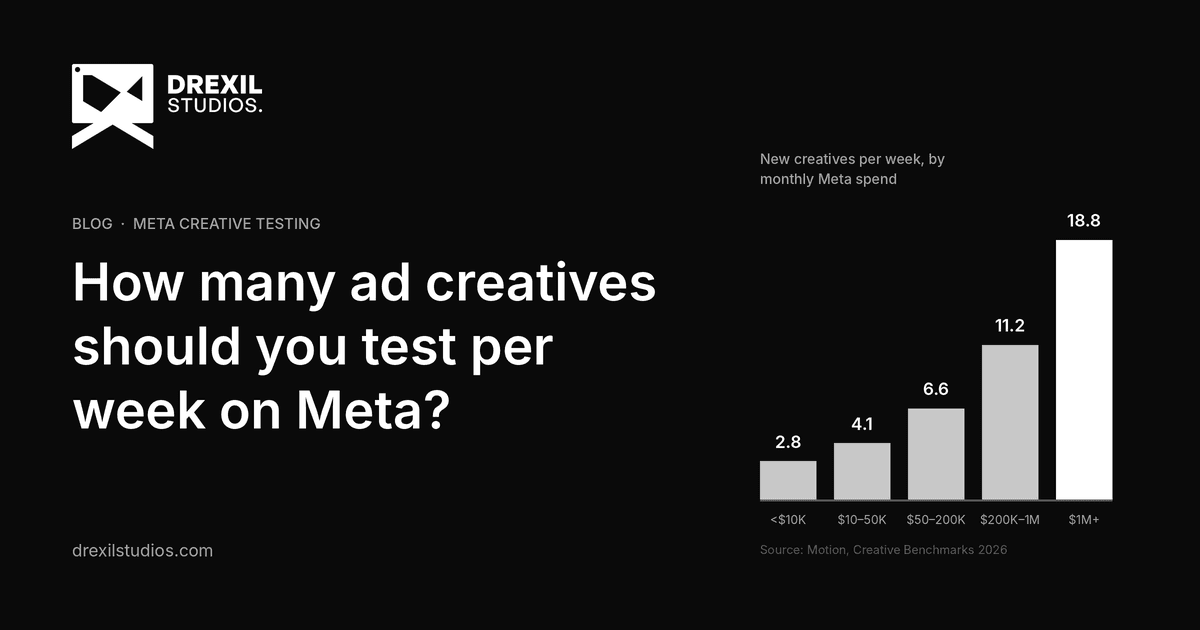
Most brands should launch 3 to 10 new ad creatives per week on Meta. Your exact number depends on your monthly ad spend, because every ad needs enough budget to show whether it works.
Test too few and your best ads wear out before a new winner appears. Test too many and each ad gets too little spend to tell you anything. This guide shows what advertisers at each budget actually test, how to work out your own number, and how to keep up with it.
The short answer by budget
Motion’s 2026 creative benchmarks group Meta advertisers by monthly spend. This is how many new creatives each group launches per week on average, and how often those creatives become winners.
| Monthly Meta spend | New creatives per week | Hit rate |
|---|---|---|
| Under $10K | 2.8 | 4.0% |
| $10K to $50K | 4.1 | 6.4% |
| $50K to $200K | 6.6 | 8.1% |
| $200K to $1M | 11.2 | 8.6% |
| $1M and above | 18.8 | 8.8% |
Source: Motion, Creative Benchmarks 2026. Hit rate is winning creatives divided by total creatives tested.
These are averages. The top 25% of accounts test far more. In the $50K to $200K tier, they launch 15.9 creatives a week, against an average of 6.6.
Now look at the hit rate. Even at the highest spend, fewer than 1 in 10 creatives becomes a winner. That is why volume matters.
Why your budget sets the limit
Every creative needs enough spend to give a fair result. Split a small budget across many ads and none of them gets enough data.
Meta’s own guidance shows the scale involved. An ad set needs about 50 optimization events within 7 days to exit the learning phase. At a $40 cost per purchase, that is about $2,000 a week for one ad set.
Meta also concentrates delivery on a few ads in each ad set, as Birch points out below. Extra ads in the same ad set can end up with very little spend.
Birch’s guide to testing volume follows the same logic. It suggests 2 creatives at a time on a small budget, 3 to 5 once you have a defined audience, and 6 to 10 or more a week as you scale. It also suggests spending about 2 to 3 times your target cost per acquisition (CPA) on each creative before you judge it.
How to work out your own number
You can size your weekly volume in four steps. This method is adapted from Madgicx’s guide to creative volume.
- Set your testing budget. Foxwell Digital recommends 10% to 20% of monthly spend for testing, with the rest on proven ads.
- Set a fair-read cost. This is the spend each creative must reach before you judge it. Use the same figure for every ad. Two to three times your target CPA is a practical start.
- Divide. Testing budget ÷ fair-read cost = creatives you can test per month.
- Divide by 4. That is your weekly number.
Example
A brand spends $40,000 a month on Meta. It sets 10% aside for testing, which is $4,000. Its target CPA is $40, so each creative gets $120 before a decision (3 × CPA).
$4,000 ÷ $120 = about 33 creatives a month, or about 8 a week.
These figures are an illustration, not a benchmark. Use your own spend and CPA.
If your number comes out below 2 a week, test fewer, bigger ideas. Give each one more time and more spend.
Count ideas, not files
Ten versions of the same ad are not ten tests. Madgicx draws the line clearly:
- A concept is a different idea: a new problem, offer, story or audience angle.
- A variant is a small change to one concept: a new hook, headline, image crop or call to action.
Your weekly batch needs both. New concepts find the next winner. Variants extend the life of the one you have.
Advice on the split varies, but it lands near half and half. Foxwell Digital suggests that 40% to 50% of new variants be iterations of current winners, at $50K to $100K a month. RevenueCat’s Nathan Hudson leans further toward new ideas, with at least 60% of testing budget on new concepts.
Here is one way a batch of 8 could look:
| Slot | How many | What it tests |
|---|---|---|
| New concepts | 3 | New angles or offers, each with its own hook |
| Iterations of a winner | 3 | Your best ad with a new opener, creator or length |
| Hook tests | 2 | The same ad body with 2 new first seconds |
More ads isn’t always better.
Volume is a means, not the goal. The goal is new winners.
RevenueCat warns about a creative volume trap. Teams chasing a weekly count drift into tiny tweaks, burn out, skip the analysis, and fill accounts with losing ads that teach them nothing.
Track one number to stay honest: cost per winner. Add your testing spend and production costs, then divide by the number of winning creatives. If cost per winner rises as you add volume, slow down and test bigger ideas.
Signs you are testing too few
- Your top ad’s click-through rate keeps falling while cost per click rises. Northbeam lists both as early signs of fatigue.
- One ad has carried most of your spend for weeks.
- No new creative has beaten your best ad in the last month.
- Comments like “Why do I keep seeing this ad?” start to appear. Pixis treats these as an early warning, before the numbers drop.
Any of these means your pipeline is too thin. The next winner needs to be in testing before the current one fades.
A simple weekly testing rhythm
| Day | What happens |
|---|---|
| Monday | Review the tests that have reached their fair-read cost. Check fatigue on your top spenders. |
| Tuesday | Brief new concepts. Pick the winners to iterate. |
| Wednesday and Thursday | Produce the batch. |
| Friday | Launch the whole batch together. |
Launch new ads together, not one at a time. Adding an ad to an ad set counts as a significant edit and can restart learning. A shared launch also gives every ad a similar start, so the results are easier to compare.
How to keep up with 8 to 10 ads a week
For most teams, the limit is not ideas. It is production. Adnova makes the same point: many small teams settle for 3 or 4 ads a week because they can’t make more.
Here is how we run production for each client at Drexil Studios:
- Research first. Before the first call, we study the client’s brand, offer, current ads and audience.
- A one-on-one kickoff. The client walks us through goals, products and what has worked before.
- A written brief. The client’s brief document is the source for every concept we make.
- Dedicated editors. Each client has editors assigned to their account, so nobody relearns the brand each week.
- Same-day turnaround. Work moves the day it is briefed.
- 8 to 10 ads a week. Enough for a full weekly batch of concepts, iterations and hook tests.
Example from our work
A US skincare brand selling direct to consumers was testing 5 new ads a week. With us, that rose to 8 to 10 a week.
Over 3 months, the client counted 5 winning ads from that volume.
Client-reported figures. Ad results also depend on the client’s targeting, budget and offer.
If you produce in-house, a few habits help:
- Brief the whole week’s batch in one sitting.
- Keep a hook bank: a running list of openers to test on your winners.
- Capture extra footage on every shoot, so iterations don’t need a new one.
- Log every ad with its concept, hook and result.
Frequently asked questions
How many ads should I put in one ad set?
Common practice is 3 to 5 ads per ad set, according to Lebesgue. Some teams test one ad per ad set to control how spend is split.
How long should a creative test run?
Long enough to reach your fair-read cost. For formal A/B tests, Meta recommends at least 7 days and no more than 30.
What share of my budget should go to testing?
Foxwell Digital suggests 10% to 20% of monthly spend, with the rest on ads that already work.
Should I test new concepts or new hooks?
Both. New concepts find your next winner. New hooks extend the life of the one you have.
Your next step
Work out your number: testing budget ÷ fair-read cost ÷ 4. If it is higher than your team can make each week, that gap is the problem to solve.
If production is your bottleneck, book a call with Drexil Studios.
Sources
- Motion, Creative Benchmarks 2026: testing volume by spend tier
- Meta Business Help Center: About the learning phase
- Meta Business Help Center: A/B test duration
- Birch: How many ad creatives should you test?
- Madgicx: Ad creative volume
- Foxwell Digital: How much creative is needed by volume
- RevenueCat: The creative volume trap in Meta ads
- Northbeam: Ad fatigue in digital marketing
- Pixis: 7 signs you should update your ad creative
- Lebesgue: Facebook ads learning phase
- Lebesgue: Multiple ads per ad set vs one ad per ad set
- Adnova: How many Meta ad creatives should you test?